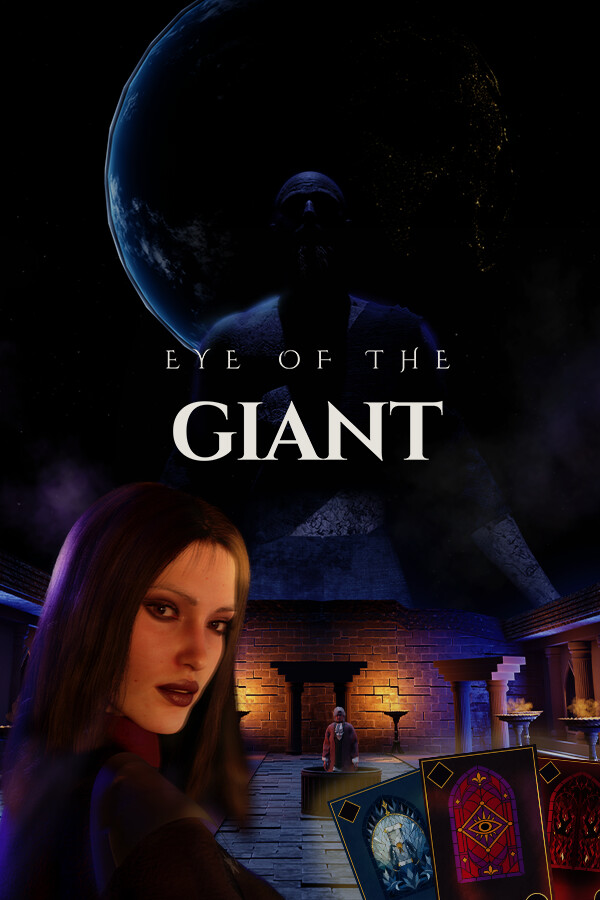
Eye of the Giant
価格比較
PUT HISTORY ON TRIAL
Eye of the Giant is a roguelike deckbuilder about interrogation, judgment, and psychological warfare.
You sit as Judge in a courtroom outside of time. Your defendants are not monsters or fictional villains. They are the figures who shaped history: Isaac Newton. Genghis Khan. Odin.
They cannot be killed.
They can only be broken down, card by card, until they confess.
Or until you decide they should be forgiven.
The verdict is yours.
THEY DON'T HAVE HEALTH BARS. THEY HAVE PRIDE.
Every defendant enters the courtroom with four psychological states instead of HP:
SANITY — Their grip on reality. Push it too far and paranoia takes over their deck. Break it completely, and the defendant loses their mind before they can confess. A madman cannot tell you the truth.
CONVICTION — Their belief that they were right. The stronger their conviction, the harder they fight back.
ARROGANCE — Their defenses. Threats, bluffs, accusations, and pressure can all be turned aside by a defendant who still believes they stand above judgment.
GUILT — The only path to confession. Break the other three, and the truth can finally surface.
Every defendant has a breaking point.
Your job is to find it.
EVERY CARD IS AN ACCUSATION
You don't simply drag cards onto an enemy.
Each card is placed into the Decision Point at the center of the bench. From there, it burns away as it leaves your hand, becoming an accusation, manipulation, threat, or revelation that crosses the courtroom.
The defendant responds according to their current state.
A barrier.
A justification.
A counterattack.
A confession.
Or something you did not expect.
Use the Rotten Apple against Newton and he may begin to explain himself. He may tell you about the crippled child. He may convince himself that he had no choice.
His excuse can strengthen his Arrogance while reducing his Guilt.
The right accusation is not always the one that deals the most damage.
Sometimes, it is the one that makes a defendant believe they are right.
TWO JURORS. ONLY ONE STAYS.
You are not alone in the courtroom.
Lilith and Elysa move around the bench as you work. They whisper. They argue. They influence your decisions.
One pulls you toward mercy.
The other toward cruelty.
Both sound reasonable.
Both are certain they are right.
Their influence changes more than dialogue. Their affinity affects the cards available to you, the choices presented during trials, and the direction your judgment takes.
But there is a limit.
You cannot keep them both.
Choose one, and the other will remember.
EVERY VERDICT REWRITES THE WORLD
Your trials do not end at the courtroom door.
Every verdict changes the world below.
After each session, the bailiff Sadık brings you the Daily Paradox — a newspaper from an Earth quietly rewritten by your decisions.
Some headlines will look familiar.
Some will describe events that never happened.
Some will contradict everything you thought you knew.
And some will be about you.
Acquit or condemn.
Forgive or punish.
There is no guaranteed good ending and no guaranteed bad one.
There is only your judgment — and the world that follows it.
THE GIANT IS NOT YOUR JUDGE. HE IS YOUR JAILER.
You are not a body.
You cannot die.
When your judgment fails, a voice speaks from above the bench:
“Insufficient. Judgment resets.”
The trial begins again.
Your deck scatters.
Your memory remains.
Something has been watching from above the courtroom.
The Giant has been bound to this place for longer than anyone can remember. He has watched the greatest minds in history stand before the bench, one after another.
He has been waiting for someone.
Someone capable of passing judgment.
Someone who might finally understand why this courtroom exists.
You woke at the bench without a name or a past.
Sadık says the previous Judge did not last long.
He says it like he has said it before.
The files keep coming.
Newton.
Genghis Khan.
Odin.
And countless others.
Nobody tells you why you were chosen.
IN EARLY ACCESS
The opening trials, from the Whisperer's first tale to the Judgment of Sir Isaac Newton
The complete four-stat psychological combat system
The Decision Point card system and starting card pool
The jury affinity system featuring Lilith and Elysa
Multiple verdict outcomes for each trial
The Daily Paradox, revealing how your judgments reshape the world